Translate

Showing posts sorted by relevance for query solar. Sort by date Show all posts

Saturday, April 11, 2015

Solar collectors and panels explained

I am often surprised when I come across people who are unaware of the difference between a solar panel a.k.a. PV (photovoltaic) panel and a solar collector.  Both types are seen installed on sloping roofs that face south.  (They are never seen on north facing roofs in the northern hemisphere, so if you are lost and see them on a roof you can generally assume they are facing south). So for those who do not know the difference, here is a simple clarification.

http://www.greenspec.co.uk/building-design/solar-collectors/A solar collector is a device that absorbs heat from the sun which is then used directly or stored in a tank inside the home.  Collectors can be used for both building heating and domestic hot water heating.   Here is a very basic diagram showing how it works.

The principle is similar to leaving a garden hose out on your lawn on a sunny day - the water will come out warm.  Collectors are much more efficient and sophisticated version of this.

There are essentially two types of collectors.   Flat plate collectors are often confused for solar panels because they are large rectangular devices with glazing on the front.  Inside there are sheets of black metal heat absorber material coupled to copper plumbing.
http://www.greenspec.co.uk/building-design/solar-collectors/

The other type of collector is an evacuated tube collector like this:
These collectors have a heat absorber pipe inside something that is similar to a glass thermos bottle.  Heat is transferred to the plumbing manifold header at the top.  The vacuum glass tube prevents heat loss and improves efficiency.

On my property I use flat plate collectors on my house to heat water, and on my workshop building to heat the building via radiant floor and radiators.   Both systems also use small solar panels to provide electricity for the circulation pumps that pump the antifreeze fluid through the collector to the storage tank.  Due to the lower cost compared to solar electric panels, both of these systems generally have had a much shorter return on investment than solar electric systems.

Wednesday, November 5, 2025

Adding 4 solar panels on the ground

Solar arrays on my workshop

 My solar power system consists of 37 solar panels mounted on my workshop building and another 250 W panel mounted on my house facing south.  The original 30 panels were only rated at 175W when I installed them 16 years ago.  Then I added additional panels rated 2 tilting 245 W panels and 6 more 375 W.  The problem is in the last few years I have added heat pumps which draw an enormous amount of power during the winter months and my electric bill shoots up from zero (actually, $42 minimum connection fee charged by my utility for the "privilege" of being connected!) through the summer to over $300 in January and February.

With electric rates increasing dramatically I am looking at options.  In my home I'm shifting back to using a propane heater for my living room because the heat pump is unreasonably expensive to operate and in both buildings I'm using more firewood to offset the use of heat pumps and fossil fuel.

Last winter when my propane automatic standby generator failed I was without power for four days and this was unacceptable so I purchased two solar panels and a battery generator as documented in this recent post.  Then in the spring I decided to use the battery generator as a backup power supply for my 3D printers and stored the solar panels inside my workshop.  I realized this was pointless because I was literally losing money from energy these two panels were not generating.


So this October I decided to deploy those two 195W bifacial panels and add a couple more similar panels but they're not bifacial, however monocrystalline panels are much more efficient in low light.  Bifacial panels can generate up to 15% more power from the back especially when there is snow on the ground to reflect light onto the back. 

The panels are facing south and tilted up at a high angle to account for the low winter solar elevation angle. 

Panel specs 


Here's a back view showing the bifacial panels on the right.  These are all made by a company called Eco-worthy who make very high quality and very affordable panels and I bought them on Amazon.


 I made my own mounting system using aluminum L extrusions that I riveted together.  This cost me roughly $40 per panel and should hold up well.  The whole mounting system folds up flat so I can take it down and store it should I need to.  Clearly, I will need to shovel snow away from the bottom of these panels in the winter.  But that's no big deal to me.


It's fall here in Maine and the time of year where we get very strong winds so I used tent pegs to secure the bottom of the mounting brackets firmly so they won't blow over.

(in mid December we got an unusual southerly wind storm that blew them all over.  Fortunately they were not damaged and I have repaired the broken mounts and will be securing them to the ground with big screw anchors)


All of my other solar panels are connected to the grid using micro-inverters made by Enphase.  (One micro-inverter for every solar panel).  However over the last 16 years 17 of the 32 original inverters have failed.  These were first generation technology and they have been replacing the failed units under warranty with seventh generation technology, but my 15 year warranty has now expired.  My trust in that system has eroded over time and I decided to use a string inverter.  String inverters take multiple solar panels connected in series and/or parallel and convert that to 120 V AC or 240 V AC.

Series-parallel connections

I connected the panels in this configuration as shown above which is the optimal one for best energy performance and the smallest gauge power cable required to feed the solar energy to the inverter.  The inverter wants to see a DC solar input from 22 V to 65 V.  By wiring two panels in series I get approximately 44 V and then by connecting them in parallel I optimize the power delivered to the inverter


I needed a couple of Y adapters in order to connect the two pairs of panels to the main cable that feeds into the inverter. Solar power cables use MC4 connectors which snap together and form a fully weatherproof connection.   These connect to red and black 10gauge wires that go across my yard for about 15 feet where they pass through the wall and down into my basement where the inverter is.


I purchased a weatherproof cable entry cover so I can prevent weather and critters from crawling in to my house.  These are typically used on campers and boats.

Down in the basement, I was able to install the (blue) inverter right next to my breaker panel.  I used more 10 gauge wire than I needed and tucked it up in the ceiling in case I need to move the solar panels.  Power comes out of the inverter at the bottom and that power cord plugs directly into an outlet to back-feed the outlet.

This is a G2 Series Grid Tied Inverter (model SUN-1000G2-M) that I purchased on eBay very affordably.  It is rated for 1000 W and my four solar panels can produce up to a peak of 800 W so I might add two additional panels in the future which shouldn't be a problem for this inverter.

The little blue display above the breaker panel monitors a single 245W solar panel mounted to the south wall of my house.


The inverter has a very helpful color display screen that shows power being generated and also a chart of Watts versus time. This was taken around 9:00am.


I connected this AC circuit to my Emporia energy monitor so I can see live data of the energy being generated in real time.

I did a detailed blog post about the Emporia system I installed back in 2021.  It is a very affordable system that I use to monitor 8 circuits in each of my 2 buildings.  I can track energy flowing in BOTH directions - meaning that solar power shows as "negative" energy in the charts and readings.

Tuesday, June 20, 2017

Quakers in Maine host a solar farm

I am a Quaker and was raised in England where the religion began.  We are properly called: "The Religious Society of Friends in Search of the Truth", or just Friends.  I am active member of the Midcoast Friends Meeting in rural Damariscotta, Maine and we recently decided to host a solar farm on our property.

The story begins in 2015 when Pope Francis released his encyclical entitled "Laudato Si".  The remarkable document is a call to action on climate change in which His Holiness lays out the issues clearly and concisely.  He talks knowledgeably about the science (he has a degree in science), but more importantly he chastises the world for placing capitalism ahead of the well being of humanity and all life on earth.  As he said once: “God always forgives; human beings sometimes forgive; but when nature is mistreated, she never forgives.” It is well worth reading and religious communities - Catholic and otherwise - have responded all over the world by taking action.  Some have divested their investments from fossil fuels, other have installed solar panels on their church roofs, and many other actions are being taken.

Friends found his message deeply moving and several of us formed a discussion group in late 2015 to explore his message and called it the "Climate Justice Group".  We met monthly and after talking about the encyclical for a while, we felt called to take action.


3 175W solar panels installed on Meeting House roof in 2008
Over the years we had already taken many steps to "green" the building by installing 3 solar panels on the roof (back when they were very pricey).  They offset a portion of the buildings needs. We also replaced all the lights with CFLs, and more recently LEDs as they burn out.  We switched the heating oil to a blend of bio-fuel and installed interior storm windows in the winter.  Many Friends drive hybrid or plug in hybrid vehicles and 3 of us have electric vehicles (Chevy Volts and Bolt).

We were aware of a solar farm that been installed nearby.  This consists of over 170 solar panels that produce up to 50kW.  9 co-op owners get to use that energy to offset their electric bill.  Each member purchases as many panels as they need to offset as much of their energy as they choose.  The co-op leases the land from a landowner with open property to spare.

After some discussion the Meeting approved the idea of hosting a solar farm on our property and approached ReVision Energy - the largest solar installer in Maine to let them know we had a site available.  ReVision staff were very enthusiastic and actively supported and promoted the solar farm.  By the winter of 2016 the farm was fully subscribed with 9 owners and we signed papers leasing the land at the bottom of our field.  The Meeting House will get over $600 per year for the lease.


On Thursday, June 22, 2017 I got approval to turn the whole solar farm on.  Here's a picture of me activating one of the 5 inverters:
The solar array was producing 44.6kW after it was all powered up!

Here is an article in the local paper about the farm in the local Lincoln County News.

A web page for the Midcoast Friends Community Solar Farm show performance metrics. 


Here are some images showing the ReVision Energy crew installing the equipment:
installing posts and racking


rails installed


sturdy steel post with aluminum brackets


half the panels installed


5 inverters and controls

completed Midcoast Friends Community Solar Farm


Utility connecting the farm to the grid
View from the Meeting House
A few Friends were dismayed by the impact of the sight lines as seen from the front porch of the building.  So we have planted 2 dozen shrubs and bushes along the back to form a screen so we won't see the less attractive back side of the solar array once they grow in.
planting miniature arbor vitae trees
Quakers have made this statement concerning our perspective:

"Our faith as Quakers is inseparable from our care for the health of our planet Earth. We see that our misuse of the Earth’s resources creates inequality, destroys community, affects health and well-being, leads to war and erodes our integrity. We are all responsible for stewardship of our natural world. We love this world as God’s gift to us all. Our hearts are crying for our beloved mother Earth, who is sick and in need of our care."

For the whole document, click below:
Living Sustainably and Sustaining Life on Earth – The Minute from the Plenary
February 20, 2016


Hopefully our small contribution in support of renewable energy will help slow the impact of climate change.

Thursday, July 25, 2024

Emergency solar powered battery generator


Last winter we had a power failure which is something that happens often here in rural Maine due to snow and wind storms, but what was unusual was that my automatic backup generator didn't start.  I went out and tried to manually start it and it wouldn't go.  Turns out the valves were badly out of adjustment.


While I do have a substantial solar power system, it is grid inter-tied which means that it must power down in the event of a power outage so it cannot feed power back into the grid and harm the line workers.  I can't affort a huge whole house battery system like the Tesla Powerwall which would cost over $20,000.


So I was without power for four days, and that was quite tedious to say the least.  I had to keep wood stoves going in both my home and workshop to keep them warm and I was melting snow to flush toilets - and also peeing outside as often as practical.  I did have an old car battery and a 300 W inverter that I could use to power my phone and a few lights, but without Internet I also didn't have any entertainment other than what I could do on my phone.  However, my biggest concern was losing food in my fridge and freezer.


So I purchased a factory reconditioned Ecoflow Delta 2 solar generator for under $600.  This amazing device can put out over 1800W to power AC devices like lights, and my refrigerator.  It also has multiple USB charging jacks.  But more importantly, it can charge from solar, vehicle 12 V power, or AC power from an outlet. 

Since this unit can be charged from solar panels I did a lot of research and found a couple of Eco-Worthy 195W solar panels for about $300 so that I could charge the Ecoflow when the power has failed.  These are bifacial panels meaning that they can gain solar energy from both the front and the back.  In the winter with light reflecting off the snow this can add 15% more power.  Since power outages frequently happen when there is snow on the ground, I figured this was a smart move.
In order to get the solar power into the house, I drilled a hole through the wall and installed a short length of PVC pipe that I can cap on each end. 


I connected the two solar panels together with large hinges so I could fold them together face-to-face.  I then purchased a bunch of aluminum angle and riveted it together to create a tilt stand.


With the panels folded up I can easily move them on a dolly - they weigh over 40 lbs.  So I can store them in my workshop and deploy them easily.


 To connect the solar panels to the generator I purchased a special 12AWG 25FT Solar to XT60i Cable for that purpose.  The orange plug goes into the generator and the black MC4 plugs connect to the solar panels.  I wired the two solar panels in series so one just connects to the other then this cable connects to the other remaining ends.


 This photo shows the generator powering my refrigerator at 269W.  The generator is completely silent and uses lithium iron phosphate batteries that can be deep cycled thousands of times.


I drilled a hole in the floor and ran an extension cord down into the basement, along the basement ceiling, and back up behind the refrigerator which is about 20 feet from the generator.  You can see the cable going down to the floor in the picture on the left.


So now I leave the extension cord plugged into the outlet for normal usage, but when the power fails I simply move it over to the generator, turn on the generator, and then deploy the solar panels.


This system gives me a sense of security because my automatic standby generator is old (1200 hours of run-time) and could fail again in the future.  While this system does not provide enough power for my well pump, it does give me plenty of power to run my fridge, lights, TV system etc.  

In my initial tests at this time of year when there is plenty of sun the solar panels can charge generator in several hours.  Then the generator can run the fridge for over 16 hours each day and I could let it coast for the other few hours since I would not be opening the door at night.  

If there was not sufficient sun, I could always take the generator over to my car and plug it into the accessory outlet to charge it.  My Chevy Bolt EV has over 45 kW of battery-power that I could use sparingly.  My automatic backup generator does not provide power to my charging station, but I could go to a public charging station top off the battery in my car if needed.

If I need more battery capacity, I can purchase an ECOFLOW DELTA 2 1024Wh LiFePO4 Expansion Battery for about $500.  It's about the same size and shape as the generator and sits on top and would double the capacity of the system.

While this system is not cheap, it does provide real peace of mind.  And I could also use the generator to run power tools in locations where there is no power such as up to camp or my backwoods where I might need to run an electric chainsaw.

Saturday, January 17, 2015

Berkeley Study: Solar Adds $15,000+ to Average Home Value

This article is re-printed from the the January 2015 newsletter from Re-Vision Energy, a solar energy installer based in Portland Maine.

Many prior studies have suggested that solar adds to a home's value, but they have often been limited in time range and geographic scope. Now, a team of scientists from Berkeley Labs, in partnership with universities and appraisers, has found that solar unequivocally improves the value of a home, on average by an amount of $15,000.

The data is based on analysis of "almost 22,000 sales of homes, almost 4,000 of which contained PV systems in eight states from 2002 to 2013—producing the most authoritative estimates to date of price premiums for U.S. homes with PV systems."

Some key findings:
  •    There was no statistically significant difference in the solar premium between new and existing homes.
  •    While not conclusive, the study suggests that solar, regardless of size, adds a special appeal to home buyers (the 'green cachet'), meaning that smaller systems (2-4kw) may have a disproportionately high premium relative to their actual energy production.
  •    Solar value is "statistically similar to [market premium approaches] estimated using the income and cost approaches, methods familiar to appraisers." (http://emp.lbl.gov/news/berkeley-lab-illuminates) - meaning that appraisers should be able to integrate solar valuation into already understood methods of assessing other premium features of a home.
  •    The study did find that the premium for a PV system depreciated faster than the system's output - i.e. a 1 year old system might fetch a $6/watt premium whereas an 8 year old system might fetch a $3/watt premium (even though the system is producing almost 100% of the power in year 8 as it was in year 1). On the other hand, a PV system in year 8 would have by that time repaid nearly all of the original investment to its owner, so any premium is a great deal!

So the good news for solar customers?
  1. You can feel confident that your solar investment will pay for itself, either over the life of the system as you live in your home, or by fetching a premium price should you need to sell your home.
     
  2. Studies like this make banks increasingly comfortable with solar, meaning it should continue to get easier to use a home equity loan or home equity line of credit product to invest in solar.
For the data-hounds, there is more information available online:
Report PDF2.17 MB
Full Report Fact Sheet PDF259.78 KB
New Homes Fact Sheet PDF236.39 KB

This article is re-printed from the the January 2015 newsletter from Re-Vision Energy, a solar energy installer based in Portland Maine.

Wednesday, December 22, 2021

Home electrical energy monitoring with Emporia


Click here to buy


As an energy efficiency maven, I am always interested in looking for ways to monitor my energy usage.  The more I can learn about how my energy is used the more I can figure out ways to conserve.  Over the years I have experimented with different kinds of energy monitors and just recently discovered this very affordable home electrical energy monitoring system.   

An Emporia system like the one pictured above sells for around $160.  (click here to purchase one - As an Amazon Associate I earn from qualifying purchases.
This system allows you to monitor 16 separate circuits in your circuit breaker box.  A smaller 8 circuit system sells for around $100.  I have installed two of these systems, one in my workshop that also feeds through to the house and a separate system in the main breaker panel of the house.  

They also sell smart plugs that can be controlled by your home automation system.  These also connect into the monitoring system so you can monitor energy for specific plug in items:

I have ordered one of these to check out and might use it to monitor and control my AV system via my Alexa app and Echo devices.

Having recently installed heat pumps in both buildings and also added 5 375 W panels to my solar array, I wanted to see how everything was working out.   (I was a little shocked that my first electric bill since installing the heat pumps and upgrading the solar power system came out at over $250! - but my main reason for doing this was to stop using propane for heating both buildings and I think it will come out less expensive per heating season).

Installation is surprisingly easy so long as you're comfortable opening up your breaker panel and I had absolutely no trouble getting the system working within 1/2 an hour so.  below is a picture of my main breaker panel with the Emporia system installed:
circuit breaker panel with Emporia monitoring equipment

Yes, I know, it looks messy, but it is all safe and functional.  The system includes two very large 200 Amp current transformers at the top that measure all the power coming into the building from the utility:
200 amp current transformers installed

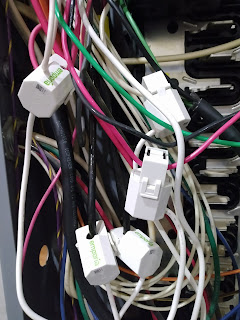
Then multiple small current transformers clip over the wires to the circuits that you want to monitor:

small current transformers installed

These are then all plugged into the monitor device that sends signals out via Wi-Fi. There is an antenna that pokes out through the wall of the breaker box that you can see in the bottom of the image:
Emporia monitoring unit installed in the breaker box

A few minutes after installing the app, I could see real-time energy data showing up in the form of graphs and lists of circuits that I had named.  I particularly like that you can configure it to record power from your solar power system.

Below is a screenshot from my phone showing my EV charging station feeding some power to my Chevy volt to keep the battery warm.  The temperature is hovering around freezing in late December here in Maine and my car draws power in small bursts to keep it warm in the winter when it's not actually charging.  While I knew this was something that was going on, it is educational and informative to see exactly how much power and how often it is used to keep the car battery warm.  Keeping the battery warm dramatically extends its useful life.

 
This screenshot shows a weeks worth of data for my house.  Clearly, the heat pump is the biggest energy user followed by a small 1.2 kW electric heater used in my small bedroom at night (the master bedroom is heated by propane).  Solar power in this breaker panel comes from one 240 W solar panel mounted on the side of the house.
list of circuits and the energy they are using

 This screenshot shows daily solar energy produced by my entire solar array of  36 solar panels:

screenshot showing my solar energy system daily generation

And this screen shows the hourly solar output for the last couple of days:
screenshots showing hourly energy produced by my solar system

Yes, the solar days are quite short in December here in Maine!

It is said that knowledge is power, so I am feeling quite empowered by all of this useful information!   I find myself opening the app on my phone several times a day and poking around through all the information to see what I can learn.  It is particularly interesting to watch the real-time chart updating every second to see the energy cycles of things like the heat pump, well pump, solar power system and EV charging station.